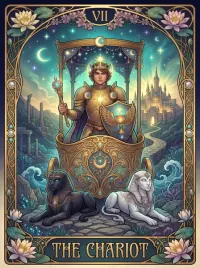
 The Chariot
The Chariot on Option A — commit and steer
Momentum is available on this path, but only if it is chosen deliberately. Half-committing to a Chariot road produces the worst version of it.
Full card meaningGuide
Use tarot for a decision by drawing for each option separately, then comparing the readings — never by asking the deck to choose. One draw per path shows what each road is actually made of, including the cost you have been refusing to look at.
A single card cannot compare two futures. What it can do is describe one of them. So split the question: draw one to three cards for Option A, the same for Option B, and read them as two separate short readings before you compare.
The comparison is usually not close once it is on the table. One option tends to describe movement and one describes maintenance — and you generally already knew which was which.
Two of Swords is the blindfolded pause: the information is available, the choosing is not. Seven of Cups is too many options held at once, most of them imaginary. The Hanged Man is the useful version of delay — a genuine suspension where waiting changes the picture.
If any of these dominates a reading, the honest interpretation is that the decision is not ready. Read for what is missing rather than for a verdict.
The Chariot is directed will: pick one road and hold the reins. Justice is the consequence card — it asks which choice you could defend honestly a year from now. Eight of Cups says the answer is departure even though nothing is objectively wrong.
When a decisive card lands on one option and a stalling card lands on the other, you have your reading.
The ChariotMomentum is available on this path, but only if it is chosen deliberately. Half-committing to a Chariot road produces the worst version of it.
Full card meaning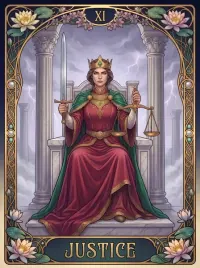 Justice
Ask which version of the choice you could explain honestly later. Justice rarely comforts, but it removes self-deception from the comparison.
Full card meaning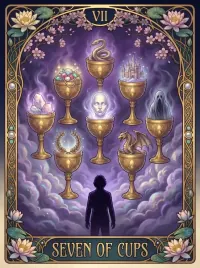 Seven of Cups
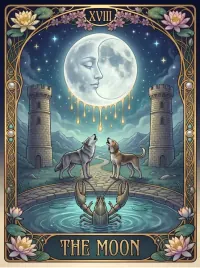 The Moon
Imagined options plus withheld information. Do not decide yet: identify the one missing fact that would collapse most of the options, and go get it.
Read this combination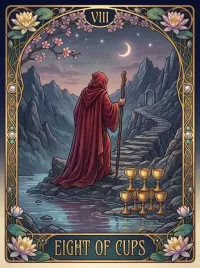 Eight of Cups
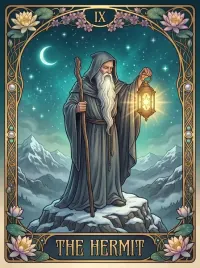 The Hermit
Nothing is wrong, and you are still going. This pair validates decisions that look irrational from outside and feel obvious from inside.
Read this combination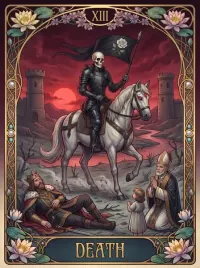 Death
Death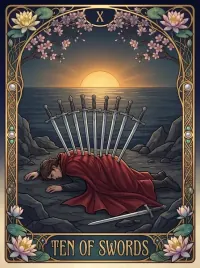 Ten of Swords
When this pair lands on an option, the decision is often retrospective: the thing has ended and the remaining choice is how you close it.
Read this combinationLay out the decision spread, or decode the cards you already drew for each option.
Open the decision spread